

A Texas personal injury lawyer’s perspective: How carriers build denial machines and to break them.
A Denial Is Not a Verdict
Before I went to law school, I was an electrical engineer. Engineers are trained to look at a black box and ask the question—what’s inside, and what rules does it follow? Engineers excel at breaking down complex, unknown, systems by observing their inputs and outputs to map out the underlying logic.
This curiosity is exactly what drives reverse engineering, system analysis, and complex problem solving that engineers thrive on. And, that instinct has proven to be the most useful thing I’ve brought to the personal injury law practice in Texas. Because when an insurance company denies your claim, I don’t see it as receiving a judgment. To me, it’s merely an output received from a system. A system with outputs and inputs, thresholds, scoring rules, software—and a business objective that is definitely not in the interest of your recovery.
However, systems have specifications, specifications have failure modes, and under Texas law many of these failure modes are actionable. So, for example, when an insurance company tells you that they have “determined that your injuries are not related to this accident,” my first question is never, is what they say true. Instead, I simply want to know exactly how the conclusion was formed; and also, how can I make them show their work.
Why Carriers Want to Deny Your Claim
Let’s talk about incentives, because their incentives explain everything else.
An insurance company’s profit is premium minus losses minus expenses. Claims paid by the insurer are the largest controllable variable in that equation. That is, every dollar not paid out on claims goes into reserves, and accounts that earn investment income while it sits. For the same reasons, “delay,” has positive expected value for the insurance company even when payment is inevitable. Therefore, from a business perspective, a denial is not an accusation against you—it is simply a business decision based on margins.
What They Actually Say
The stated reasons are rarely the real ones. Here is the standard catalog of excuses, translated:
- Their letter says: “your Injuries are not consistent with the mechanism of the crash,”
- What it means: “my low-speed-minor-impact biomechanical computer model said, the forces were too small to cause your injuries.”
- Their letter says: “you have a pre-existing degenerative condition,” What it means: “your MRI shows disc desiccation at LS-S1” – which nearly every adult over 30 has.”
- Their letter says: “you not hurting, you have a Gap in treatment,” What it means: “Not our fault that you waited nine days to see a doctor, because you were trying to keep your job.”
- Their letter says: “So, your treatment was excessive and really not medically necessary,” What it means: “a vendor bill-review program repriced your care.”
- Their letter says: “Liability is disputed / Comparative fault,” What it means: “there’s a coding error on my computer screen or ‘our’ insured told a different story first.”
- Their letter says: “minor property damage,” What it means: “we’re relying on the Bumper photos to determine the occupant forces.”
Notice how many of those are technical positions dressed as medical or legal conclusions. That matters, because a technical position can be tested.
So, What’s Under the Hood Here
This isn’t a conspiracy theory. It’s public record. Patent applications are published documents that anyone can read; and they describe in the applicants’ own words what these systems are designed to do. Here are a few real examples worth knowing:
- U.S. Patent 11,403,712: State Farm Mutual Automobile Insurance Company – “Methods and systems for injury segment determination” (August 2, 2022) –- an algorithm that decides how seriously your injury will be treated, and by whom, before an adjuster forms an independent judgment.
- U.S. Patent Application 2003/0200123: “Injury analysis system and method for insurance claims.” –- takes accident data and produces biomechanical metrics to evaluate whether forces were sufficient to cause the claimed injuries—that is, the technology behind “your injuries aren’t consistent with this crash.”
- U.S. Patent 11,488,256: Infiniteintel, Inc. – “Machine learning systems, methods, components, and software for recommending and ordering independent medical examinations” (November 1, 2022) — predicts IME outcomes and maximum medical improvement status from electronic medical records, scores claims for “readiness,” and automatically updates reserve accounts based on closure predictions.
Moreover, AI fits squarely in the middle of it all. This technology isn’t about faster paperwork. It is about prediction. About predicting severity, fraud, whether you’ll accept a settlement amount, and predicting reserve outcomes. The edge the insurance company gets from AI is asymmetry of information at the moment of the offer. You are no longer just a phone number and claim number. They have a model of you at this point.
How Does The Process Work
Alright. Here’s how the process actually runs in Texas, what’s under the hood, and what the law gives you.
So, someone just hit you, what now?
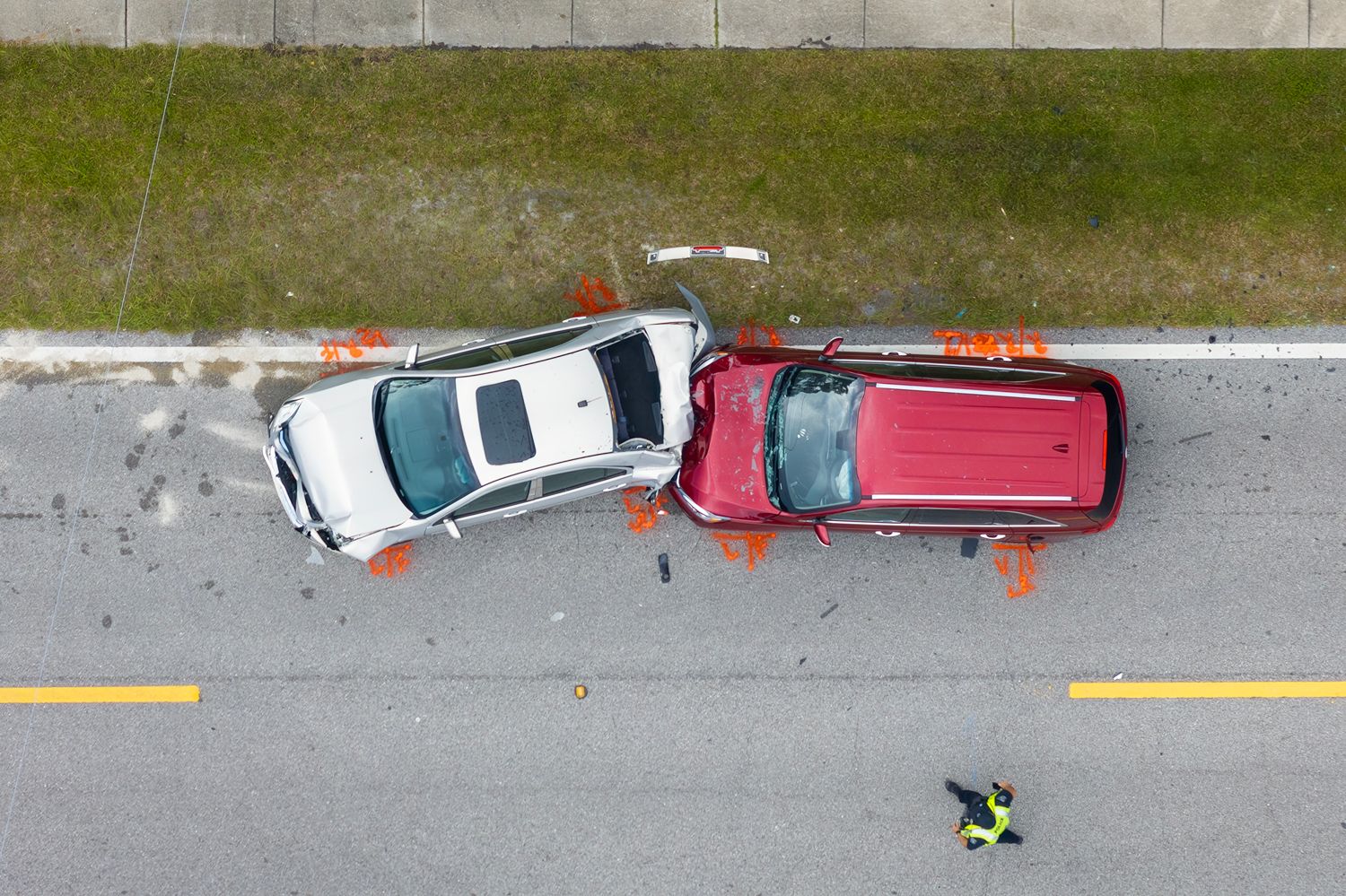
Call 911. Get a report of the accident. Give the officer the information needed to get your crash report started; but be aware, at this point, everything you say and do will likely be used against you if possible—and go get Medical treatment the same day if you can! Each gap in your treatment timeline becomes a line-item argument for an insurance adjuster regarding causation of the crash later. Next, call your lawyer and photograph everything. Photograph all vehicles involved, all corners of each vehicle involved, the interior, the airbags, the roadway and tire marks, the debris on the road, and your injuries (e.g., scratches, bruises, broken bones). Because, photos are data, data is evidence—and evidence is leverage.
In days 1 through 15, your lawyer will typically give the insurance company written notice of the claim. Under the Texas Insurance Code, a first-party insurer (i.e., your insurance company) has 15 days after receiving written notice to acknowledge the claim, begin its investigation, and request any items it needs from you. Around this same time, they will open a file, set a reserve, and will likely run your claim through automated triage system before a human ever reads it.
Days 15 through 60, a medical authorization may arrive. These should read carefully as these broad authorizations are not necessary for your claim; instead, it’s a discovery tool that lets the insurance carrier mine ten plus years of your medical history for anything it can label a “pre-existing condition.” Meanwhile, under Texas Insurance Code § 542.056, an insurer generally has 15 business days after receiving all requested items to accept or reject a claim in writing; if it accepts, they are required to pay within 5 business days of that notice.
Within 3 to 18 months or so, after your treatment stabilizes and your medical records and billing comes in, you attorney will prepare and send the insurer a demand package. This is when the real fight starts regarding causation, were your medical charges “reasonable and necessary,” and your case’s value.
What About the Stower’s Doctrine?
If your claim is against the other driver’s insurance company however (i.e., “third-party”)—not your own; in days 1 through 15, your lawyer will typically give written notice of the claim to the third-party insurance company. Be firm and clear-eyed when dealing with a third-party insurer. The 15-business day requirement under Texas Insurance Code § 542.056, does not apply to a third-party carrier. Under Allstate Ins. Co. v. Watson, 876 S.W.2d 145 (Tex. 1994), a third-party claimant generally has no standing to sue the at-fault driver’s liability insurer directly for unfair settlement practices. That is, because you are not their policyholder; they only owe duties to their insured. Thus, for a third-party claim, the leverage comes from a different direction—and it is very powerful.
The Stowers doctrine. G.A. Stowers Furniture Co. v. American Indemnity Co. 15 S.W.2d 544 (Tex. Comm’n App. 1929) imposes on a third-party insurer a duty of ordinary care in responding to a settlement demand. A proper Stowers demand requires that (1) the claim is within the scope of coverage, (2) the demand is within policy limits, and (3) the demand terms are such that an ordinarily prudent insurer would accept it. Therefore, if the carrier negligently rejects that demand and the case goes bad, the insurer is liable for the entire judgment including any portion exceeding policy limits.
That is the whole game in a serious case with thin limits. A properly constructed Stowers demand converts a third-party insurance carrier’s own insured into a person with a claim against them, and it converts your case from a fight over $30,000 policy limits—into a fight over the carrier’s ultimate financial exposure. Building one correctly with the right proof, the right terms, the right deadlines, and the right release language is precise technical work, and it is work that has to be done before their denial becomes gospel.
How X Bennett Law Fights Denials
At X Bennett Law, we don’t argue with denial letters. We falsify them. We rebuild the crash from the physical evidence. Vehicle photographs at known geometry, the collision profile, collision height mismatch, bumper reinforcement bar contact, airbag deployment threshold, and restraint performance. So, when the carrier argues “minor impact,” we make them defend the confidence of the model behind that claim, including any assumptions made about stiffness, restitution, and occupant position that the adjuster never even looked at.
We get the data the carrier hopes you won’t ask for. The event Data Recorder downloads (the “black box”), infotainment and telematics modules, camera event logs, and EDR output. We fix broken crash reports, request supplements and corrections, pull the officer’s narrative and diagram, and where necessary depose the investigating officer. We send spoilation letters and get the video evidence before it’s overwritten. Including police and sheriff body-worn camera and dash camera, 911 audio and CAD dispatch logs, TxDOT and municipal traffic cameras, business and residential surveillance, and other witness’s dash cams. Preservation letters go out early, and when they’re ignored, we’re prepared to talk about spoliation. We document the medicine properly. Additionally, if a decision on your claim was produced or shaped by an automated system, that system is discoverable subject matter. The claim file and activity log, the software used, its configuration, scores it produced, the training inputs, and the carrier’s governance documentation.
In other words, a denial letter is not the end of your claim. At times, it’s the first honest look you’ve gotten at how the other side thinks. A carrier can spend a decade and a patent portfolio building a system to minimize what it pays you. What it cannot do is repeal the Texas Insurance Code, waive the Stowers doctrine, or tell a Texas jury that a machine made the call and nobody had to check it. Texas law has said the opposite out loud.
Just remember, despite who or what is the cause of your injuries, you don’t have to fight the responsible parties alone, if your claim was denied, delayed, or lowballed, bring us the letter, the photos, the report, and the dates. We’ll take their denial apart, identify any discrepancies in the model’s logic, and work relentlessly to hold all responsible parties accountable.
X Bennett Law – Engineered Advocacy